Segregation, integration, & inclusion. Part 2
My early school days - see Part 1

“His favourite trick was to lift me from the floor by my ears …. I’m no expert, but I’m guessing that this practise might be considered to be illegal today.”
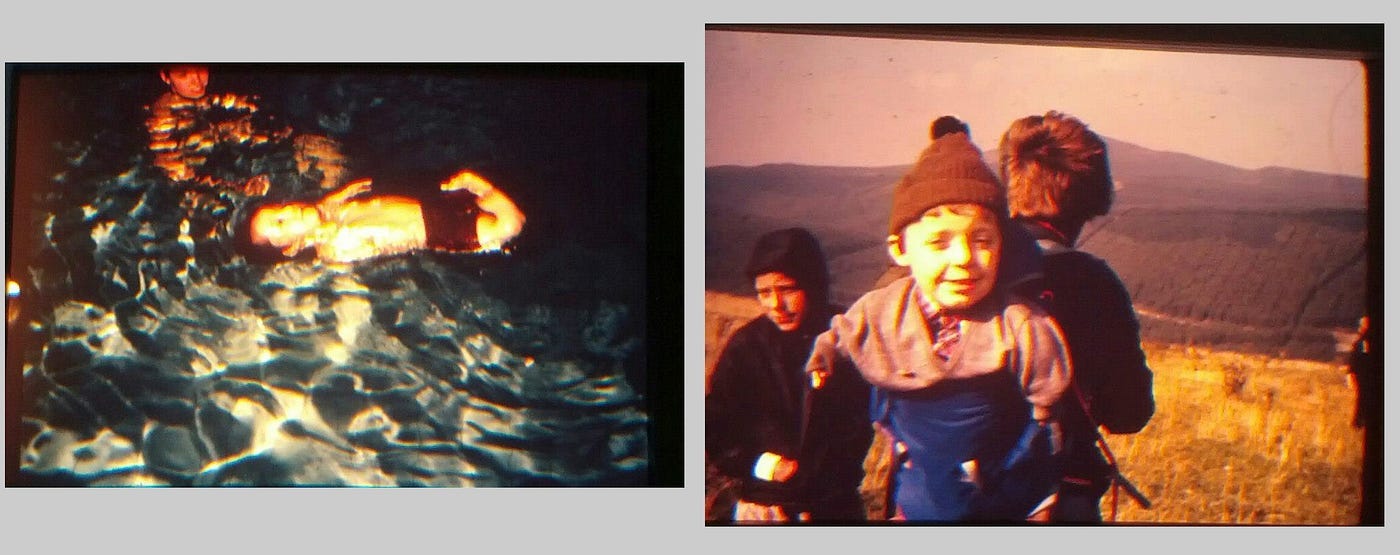
I remember going on the school holiday to Colomendy summer camp in North Wales. The teacher took it in turns to carry me up the Welsh mountains in a modified haversack strapped to their backs. I was very light in those days.
My favourite teacher was a Mr Ray. He was the oldest teacher in the school, probably late 50s but he seemed much older and he taught me in my last year there. He was very tall, wore tweed suits and smoked a pipe. He was very old fashioned [even for those days] and really strict, although most of the kids [including me] loved him. His favourite trick (and he loved showing this off to other staff members) was to lift me from the floor into my wheelchair by my ears. In reality he would cup my head in his hands just below my ears and lift me up that way. I always stayed rigidly still, scared that my head was going to pop off.
I’m no expert, but I’m guessing that this practise might be considered to be illegal today.
‘Integration’ was the buzzword at the time and I think it was appropriate. It wasn’t quite full inclusion and they did get some things wrong. They tried to ‘normalise’ us as much as possible so we would ‘fit in’, which is fine. But sometimes our differing needs were overlooked. For example in the early years the desks were very low. When I wore my artificial legs I had to stand in them all day as I couldn’t sit down in them; they didn’t bend at the knee. Consequently I had to lean forward and bend right down to reach my desk. My back would be in agony and my handwriting was pretty much illegible. Sometimes I would lean forward so much that I would literally fall over the desk. So they came up with a solution. Now you might think the obvious solution would be to get a higher desk. Oh no. Instead, they tied a strap to a radiator pipe and the other end around my waist, so I was literally tied to the wall. At least I didn’t fall over my desk. But I still had to bend right down and my back still ached.
Unfortunately there are no photographs of this. But plenty of witnesses, including the girl you saw in the video struggling with the doors entering the school. She was also strapped to the same radiator, standing next to me. You can see her in the group photo at the top, sitting front row on the left. Her legs are sticking straight out, as they didn’t bend at the knee either.
I’m no expert, but I’m guessing that this practise might be considered to be illegal today.
Despite not getting everything quite right I absolutely loved school. I had lots of friends beyond my Thalidomider gang and during the summer break I couldn’t wait to get back.
When I turned 11, the search was on for a mainstream secondary [high] school to educate me. Since I managed successfully at a mainstream junior school, my mother assumed it wouldn’t be an issue getting a place at the local secondary school where my siblings had attended. But we faced exactly the same discriminatory attitudes. They all refused point blank to have me as their pupil.
Fortunately Highfield Comprehensive school took most of us on [one or two lucky ones managed to get into their local secondary school]. This was only a couple of miles from Dovecot, so again old Bill took me in his hackney cab, along with Helen as my safety escort.
A few years ago, Sacred Heart Catholic College (High School) in Crosby invited me to speak to the whole school assembly about disability and inclusion. I made the point that, historically, this was one of the local schools that refused to educate me. I’ve spoken about inclusion in a few schools and I modify my talks to fit the age group. For the older kids I can be a bit more political, but the younger ones are just fascinated about how I drive my adapted van.
Highfield Comprehensive had a good academic record and it was more like an old grammar school in some ways. It was huge compared to Dovecot with some 2,000 kids attending from the ages of 11 to 16. It was quite old fashioned with the head teachers wearing traditional black gowns and often carrying canes. The uniform of black blazer, white shirt,with gold and black striped tie was very smart. Discipline was very strict and corporal punishment was used liberally. In fact some of the staff were downright thugs. I knew that I wouldn’t be caned, but every single one of my non disabled friends were, some quite regularly. Anyway I was impeccably behaved. I wasn’t exactly a swat but I loved learning new things and the curriculum was varied and interesting. I only started to rebel just before my fifteenth birthday, when my father unexpectedly died [I’ll write more about him soon]. In the fifth form [now called Year 11] I’d go round to friend’s houses in the lunch breaks and on occasion skip the first lesson of the afternoon. I began smoking cigarettes and we’d sometimes get high smoking weed. We would have to cross the very busy Queens Drive dual carriageway. One afternoon returning to school my friend pushed me out into the road accidentally and a car driver had to slam on her brakes. The poor elderly driver was shook up and reported us to the school. We all waited outside the Upper School Headmaster’s room. One by one they went in and my three friends were each given four strokes of the cane. They didn’t establish who was pushing me and I wasn’t going to ‘dob him in’, so they were all punished collectively. Finally I was wheeled in. The Head solemnly told me they had considered caning me, as the matter was so grave. He spoke of the dangers of leaving the school grounds without authorisation and why it was so bad to skip classes. I pretended to be contrite but I wasn’t really. My punishment was just one hour detention during the lunch break.
I gave up the artificial legs shortly after my thirteenth birthday. Imagine walking around a huge school, carrying my book bag and trying to avoid being shoved to the floor by other kids running past. I would arrive at my class rooms exhausted, with some of the teachers giving me a disapproving look for being late. It was a blessed relief when my mother agreed that I didn’t have to wear them ever again.
During my school years I was pushed everywhere. Electric powered chairs came much later in my life. The school employed a guy to push me to and from classes. I was eleven and he seemed much older and wiser than I, even though he was only eighteen. He moved on to a better job two years later and Helen, the niece of the school nurse took over. She was really fun and much older — being in her late 20s. Although my wheelchair was essential to get from A to B, I never liked sitting in the wheelchair in class. I would always transfer to a regular seat. This continued well into my adulthood [see the video clip below at my college of further education] and I would even transfer onto cinema, theatre or restaurant seats. It was only much later that I was comfortable sitting in my power chair.
Helen didn’t always take me to class. When I made friends they would often volunteer to push me. In the earlier years in junior school they would all want to push me, so I’d sometimes end up with two kids on each of the handle bars. I’m still baffled how they ever moved in a straight line.
Like Dovecot, Highfield tried very hard to integrate us as much as they could. But also like Dovecot, they got a few things wrong. Highfield was divided into two parts, lower school and upper school. The lower school was in an old two storey red brick building from around the 1930s, the upper school was a large modern block built in the early 1970s, complete with its own lift [elevator]. There was also a separate sports block with gymnasium and [very rare for a comprehensive school] its own indoor heated swimming pool.
All the disabled kids in Highfield organised [in meetings in our medical room] a sponsored swim in aid of the children’s charity NSPCC. We declared that we wanted to help children who were “less fortunate than ourselves”. The media loved it and various celebrities attended throughout the day such as the Everton football team and the legend that was the great Liverpool FC Manager Bill Shankly, who stayed the whole day. We featured in all the tabloids and on national and local TV news, plus the BBC children’s programme Blue Peter — we were all awarded the famous silver BP badges. We swam in relays and I managed a total of a mile and a quarter. But the best swimmer by far was a lad called Jimmy who had contracted polio when he was a baby — his legs were paralysed so he was a wheelchair user, but in the water he swam like a dolphin and he completed, I think, ten miles.
All the science laboratories were on the upper floor of the old red brick lower school building. In the first two years the teachers would carry me up the stairs. The labs had tall stools and so I would be perched on top of them, holding on to the work benches desperately hoping I wouldn’t fall to the floor. Thankfully I never did. But when I hit my teens I got much heavier so unfortunately I missed out on any more science education, which I do regret very much.
During these periods I was allowed to sit in the medical room — this was a place of sanctuary for us thalidomiders and we made it a sort of common room. As well as the ‘free periods’ such as science or PE classes, we would hang around there most lunch times. The elderly school nurse, Ivy, was delightfully good fun. Between dispensing headache pills or sticking plasters to cuts she would chainsmoke and read the tabloid newspapers. I often read the tabloids with her and occasionally she’d share her cigarettes too. You don’t get school nurses like that nowadays.
Highfield had a rule that whenever any member of teaching staff entered a classroom all the pupils had to immediately stand to attention. I remember in my fourth year [year 10] our French teacher was off sick, so a supply teacher arrived. When he walked in everyone immediately stood up. I was sitting in the back row of desks with my friends. He looked in my direction, his face red with anger as he yelled “Boy! Get up!”. A few of my classmates started giggling and he bent down to look under my desk. His face went even redder and he spluttered something inaudible, told the class to sit and started the lesson.
I used to have typing lessons — I was the only boy in a class of twenty girls. they gave me an electric typewriter to use as the old fashioned manual typewriters were too clunky and stiff for me. But for all other lessons I just used pen and paper for my notes. My handwriting was initially legible if not very neat, but after a while I would get very physically tired and my writing would deteriorate to a spidery scrawl.
When it came to doing my O Levels when I turned 16 I sat in the exam hall with all the other kids. After a two hour exam I was exhausted and my handwriting was illegible. As a concession they offered an extra half hour, so all the other the kids left, whilst I sat alone feverishly writing. I failed all my O Levels apart from mathematics.
I decided to stay on in the 6th form to resit my O Levels. Now every 6th former was automatically made a Prefect and they proudly wore their dark blue and gold shields.

I was the only 6th former not given the badge. I was angry and hurt. I complained to the Head but he muttered about the role of the Prefects was about enforcing school discipline and he didn’t think I was physically capable of that and ….. blah blah blah. I wasn’t really listening. His excuses were petty, but he wouldn’t budge. I know it’s only a stupid metal badge but it highlighted my differences and I felt discriminated against.
I parted company with Highfield shortly after that. I didn’t relish being there another year and then failing in the exam hall again. So I applied to the Hugh Baird College of further education and I was accepted. This was the first educational establishment that was fairly local to where I lived that allowed me in.
They let me resit my O Levels almost immediately. I was put in a small room with an electric typewriter, an invigilator and they said I could have as much time as I needed. I passed all my O Levels and so I stayed on at the college for two years to study for my A Levels.
Being at college was two of the happiest years of my life. I began to live. I had a big gang of friends and I started dating seriously. The local pub, the Merton Inn, was one of the few drinking places that was accessible in the whole of Merseyside then. But life at home was very different. My Mother had remarried and Jim, my new stepfather, became my defacto helper. He drove me to the college and pushed me to the classes. I resented this very much. In fact I couldn’t stand him. Mainly because he wasn’t anything like my father [to be fair no-one could have replaced him, as I put him on such a high pedestal of admiration]. Plus both my mother and Jim were massively over-protective and treated me like a child, which was the catalyst for my leaving home when I was 22 [I’ll write more on this soon]. Incidentally, Mother divorced poor Jim as soon as I left home. “I only married him for your sake!” she angrily declared.
Anyway my friends soon took over the role of pushing me to my lessons, Jim just dropped me off at college in the mornings and picked me up at night. Here is a short clip of me at college, taken from a longer documentary. You can see Jim wheeling me in and pushing me into the college refectory. My friends teased the politics lecturer afterwards, saying that I must have bribed him to say nice things about me :)
From ‘World in Action — Kevin at the crossroads’ 1981 Granada, ITV — when I was aged 19. full documentary here:
After passing all 3 of my A levels in English Literature, Government & Politics and History I wanted to do what most of my peers had planned to do, go on to University to study for a degree.
I visited Manchester University and Liverpool Uni, driven there of course by Jim. They were two of the most depressing afternoons of my life. Universities in the 1980s were not adapted for wheelchair users and disabled students were as rare as Dodos. There were several factors for this; disabled kids were rarely integrated in mainstream schools, the uni buildings were not built with any thought to access [especially the old red brick ones] and there was no provision for inclusion in education in law. Even when the Disability Discrimination Act was passed in 1995 education wasn’t included — this was added later in 2001, but even then it didn’t adequately cover Higher Education. It wasn’t until 2010 with the Equalities Act that Universities were required by law to accommodate disabled students and they all started frantically rebuilding and making their campuses accessible. But in 1981 I was extremely frustrated. I remember the Student Union building at Manchester was one of the few areas I could look around. It was tantalising to see all the young louche students carrying their books, I eagerly scoured the various political posters and leaflets advertising demos pasted on the walls and I read the announcements from the multitude of Societies on the notice boards. There was quite a pungent smell of tobacco and a haze of dope floated everywhere. It was a time of radicalism and class war in the campuses of the Thatcher era. I desperately wanted to be here. Jim had a permanent scowl of disapproval on his face; he was a Tory voter — another reason to detest him. I wanted to read politics, but the lecture theatres and tutorial rooms were all up flights of stairs with no lifts.
But at the end of that balmy summer I found a full time job with Social Services, being an advisor and advocate to clients in the field of welfare rights. I’ll be writing a whole chapter in my book about my first job which was actually more exciting and crazier than it sounds.
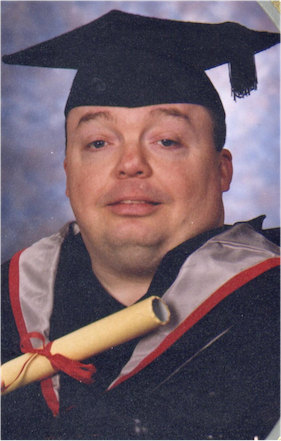
I eventually went to University in 1995 at the age of 34 [I would describe myself as an immature mature student] and I graduated in 1998 with a BA [Hons.] in Applied Social Sciences. The University was Edge Hill in Ormskirk, Lancashire. It only took me about 20 minutes to drive there. Yes I drove there myself and nobody pushed me around as I had my trusty [and fast] power chair. I’m going to write about my adventurous time at Edge Hill and what I did afterwards in another post on here soon. Edge Hill was the first university in the whole of the northwest of England to be fully inclusive and accessible to disabled students. I utterly adored the place. My late Mother came to the graduation ceremony and she was immensely proud…. but I probably might never have got there if she hadn’t fought to get me educated in a mainstream school.

*************************************
All my posts are now free to read on Substack whether you’re a member or not. If you would like to buy me a coffee it will be so appreciated and you can do so through my Ko-fi Account thank you! :)
Visit my website kevindonnellon.com
*************************************